Bringing Bobo to Life: Creating The Fake News Navigator
Fake news is everywhere. For adults it's challenging enough to navigate, but for children growing up online, distinguishing fact from fiction is becoming an essential life skill.
So how do we equip young people with the confidence to question what they see online?
That question became the starting point for The Fake News Navigator – a theatre production commissioned by Ofcom, in partnership with PK Porthcurno – Museum of Global Communications, and created alongside Cousin Jack's Theatre Company. Getting students ready for the new curriculum around critical thinking in 2028, the play was planned to tour 30 primary schools across Cornwall. Although the production was aimed predominantly at Key Stage 2 pupils, it quickly became apparent that everyone, from reception children to teachers, found something to enjoy.

Cover illustration
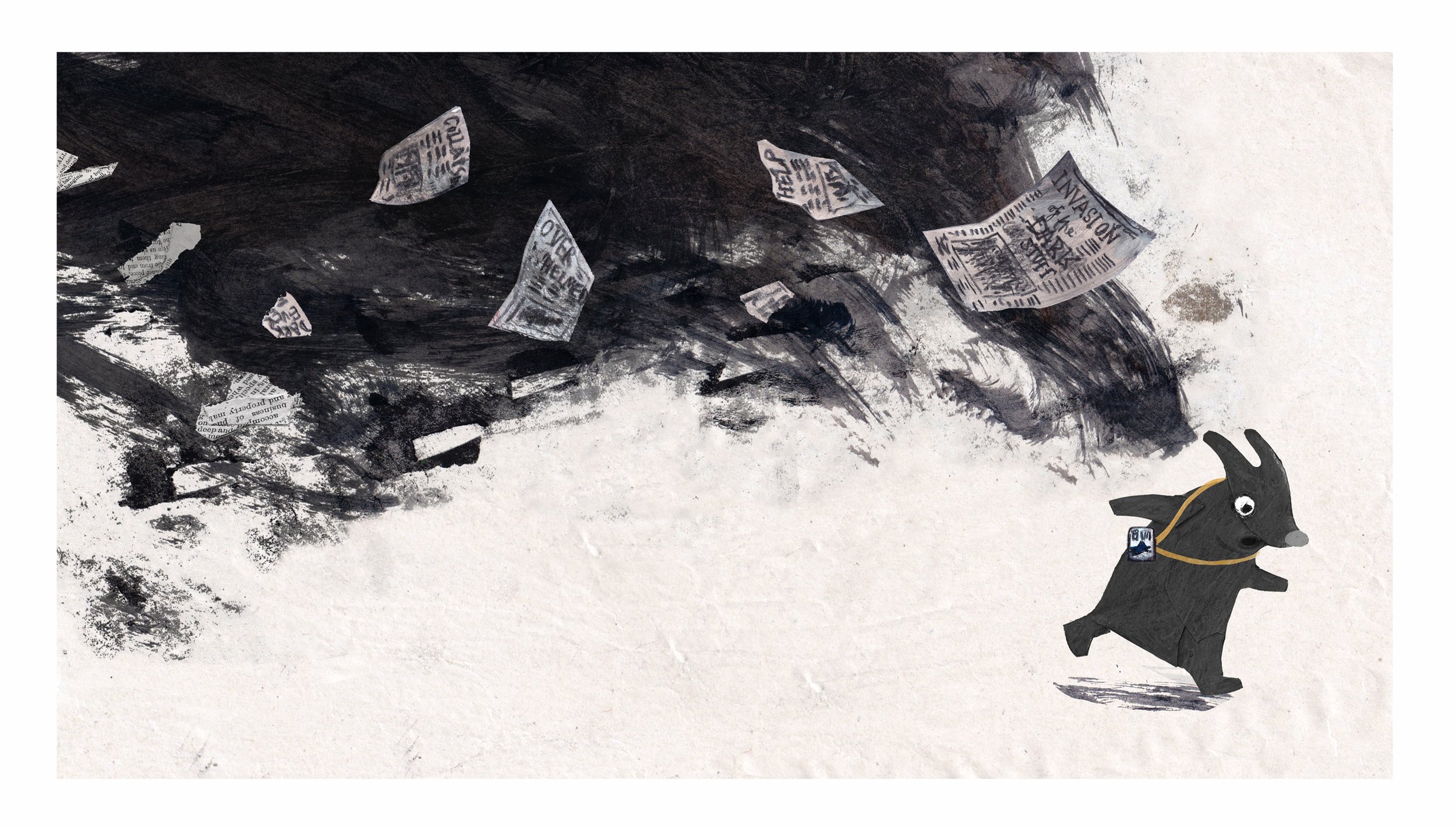
As an illustrator, I spend much of my time alone, telling stories through pictures. This project challenged me to discover what happens when those pictures step off the page and into a team process. Working alongside Guy Watson and Jonathan Bray from Cousin Jack's Theatre Company, we assembled a wonderfully talented creative team including performers, a costume designer, prop makers, a musician and a Makaton language specialist. My role was to write a brand new story featuring Bobo, the much-loved character from my picturebook The Accidental Gardener. I wanted the play to feel like a natural continuation of Bobo's world—an adventure that children would believe, invest in emotionally and, hopefully, learn something from.
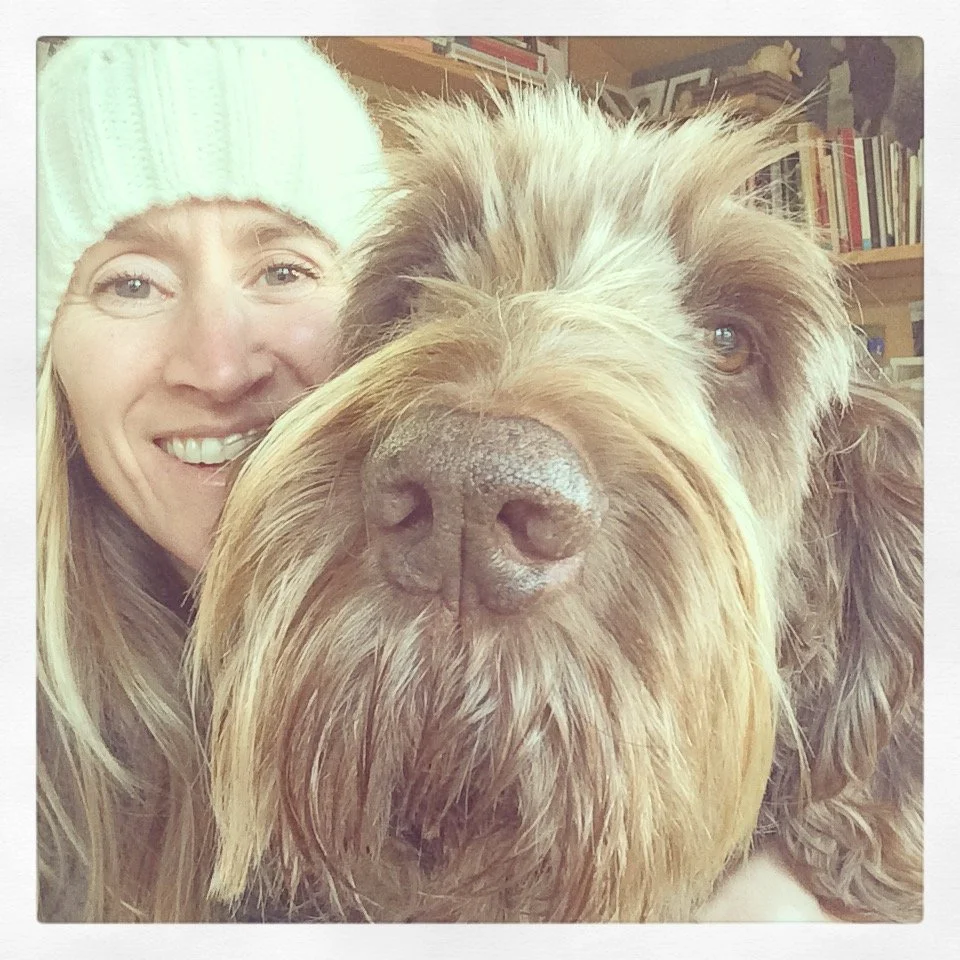
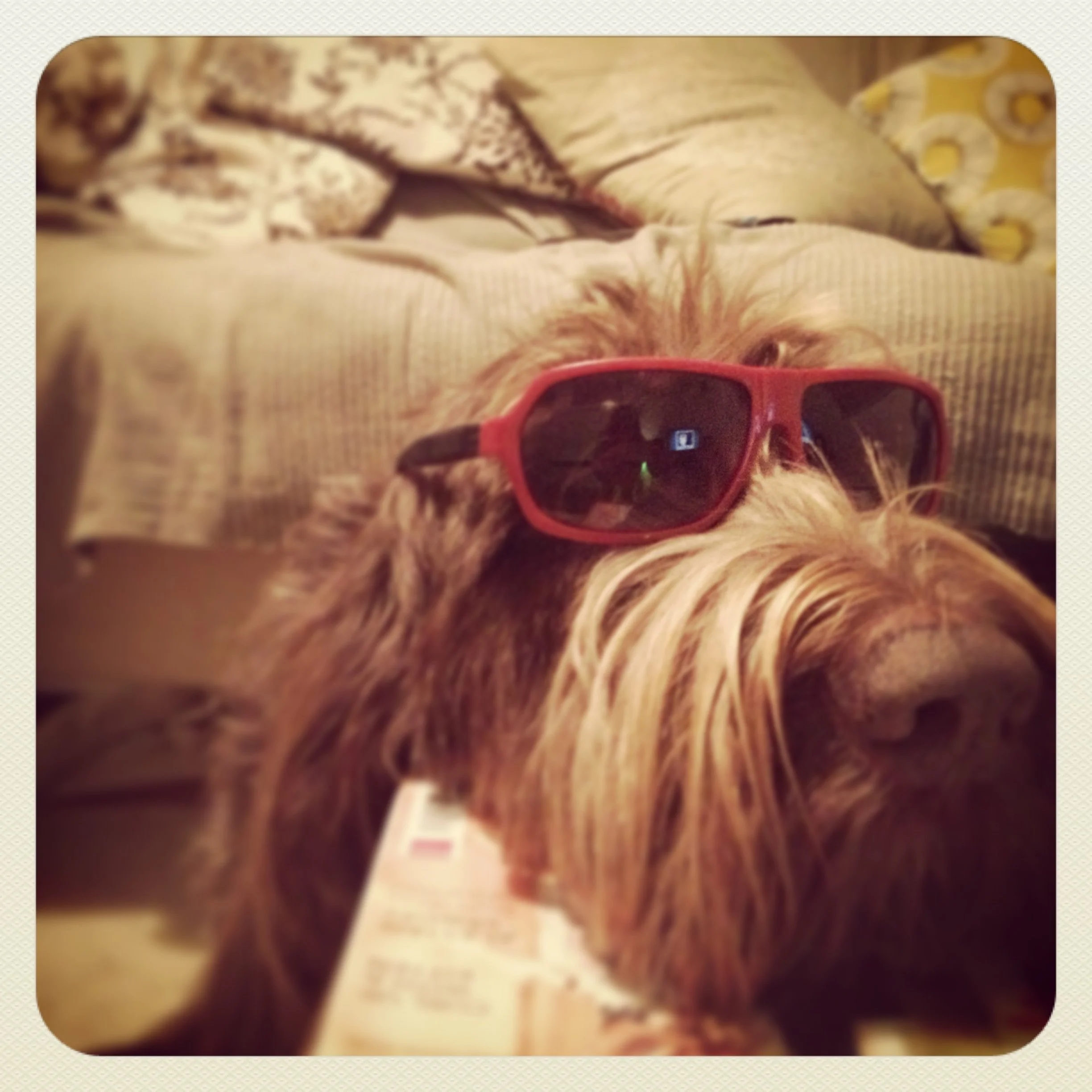
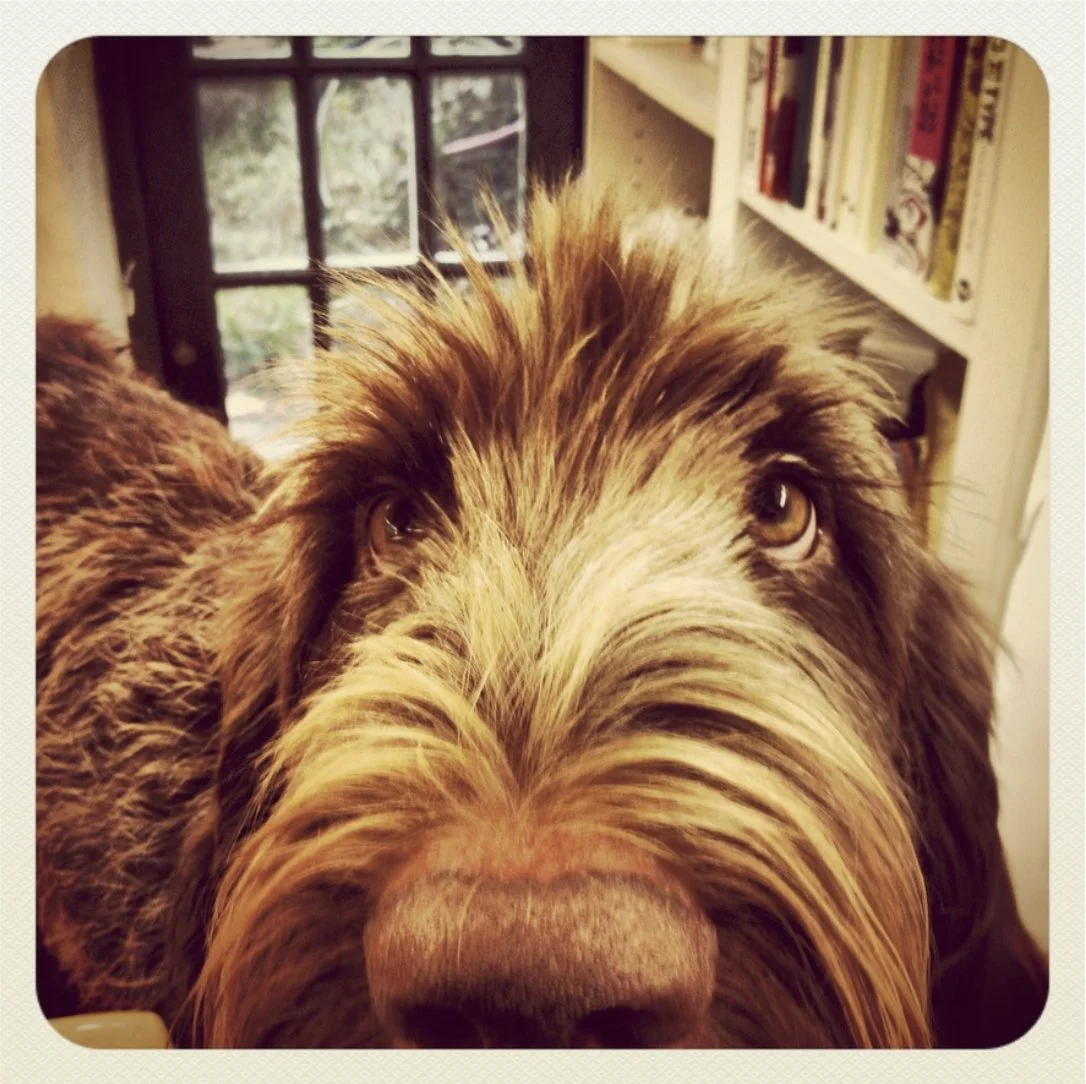
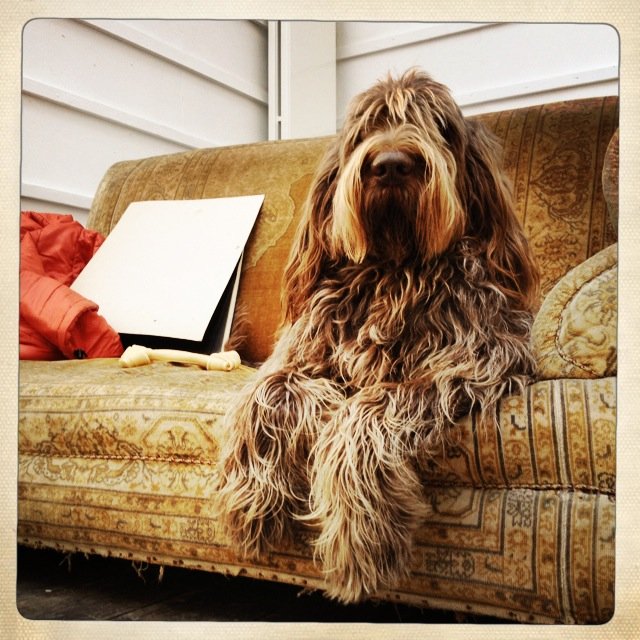
It’s important here to mention that the real life Bobo was my beloved Italian Spinone. He was my constant, my best friend, my side kick, my emotional support. Loved by all who knew him, so when he died at the young age of 10, it made a heart shaped hole in the lives of all who knew and loved him and I truly believe that his special spirit lives and thrives in the character of Bobo and why so many are connecting with him.
Bobo Meets the Internet
Bobo's world is wonderfully analogue. His days are spent gardening, listening to the radio, drinking copious cups of tea and carefully recording everything he learns in his trusty notebook.
When his prize seedling suddenly begins to wilt, none of his usual gardening wisdom seems to help. Then, over the radio, he hears an advert promising a miraculous new invention:
"THE INTERNET”
“Do you have a problem you cannot solve? then the internet will know how”
“Do you have a poorly seedling that you don’t know how to heal? The INTERNET knows!”
Curious and hopeful, Bobo phones the number advertised and orders one immediately.
What follows is a funny, chaotic and increasingly overwhelming journey through misinformation, contradictory advice and the challenge of knowing who, or what, to trust. Rather than tackling fake news through abstract ideas, we centred the story around one simple question: How do you look after a poorly seedling?
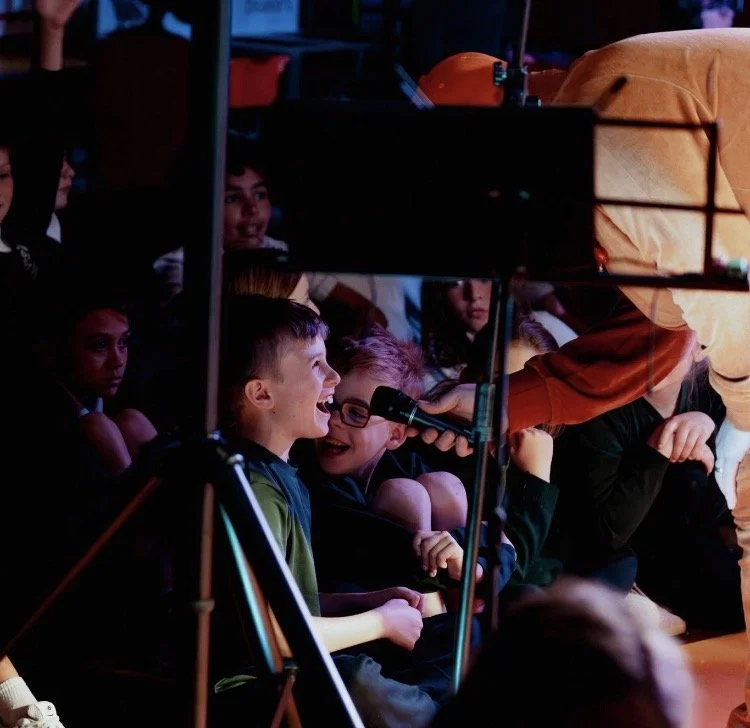
Photo by Neal Megaw
Humour became one of our greatest storytelling tools. The children laughed, shouted advice, joined in and gradually began recognising that not every answer deserves to be believed simply because it sounds confident.
The emotional climax comes after a building tension of confusion and especially when THE INTERNET repeatedly insists:
"Cut off the leaves... Cut off the leaves... CUT OFF THE LEAVES!"
Completely overwhelmed, Bobo drops to the floor, protecting his precious seedling.
During one performance, as Bobo lay there frozen with worry, I heard a child quietly whisper,
"It's okay, Bobo…it’s going to be okay."
It wasn't scripted. It wasn't prompted.
It was simply empathy.
I've received wonderful messages from readers over the years about how my illustrations have affected them, but nothing compares to sitting in the room and witnessing a child spontaneously comfort a character you created. It was one of those moments that emphasise why stories matter and why I love making and sharing my stories.
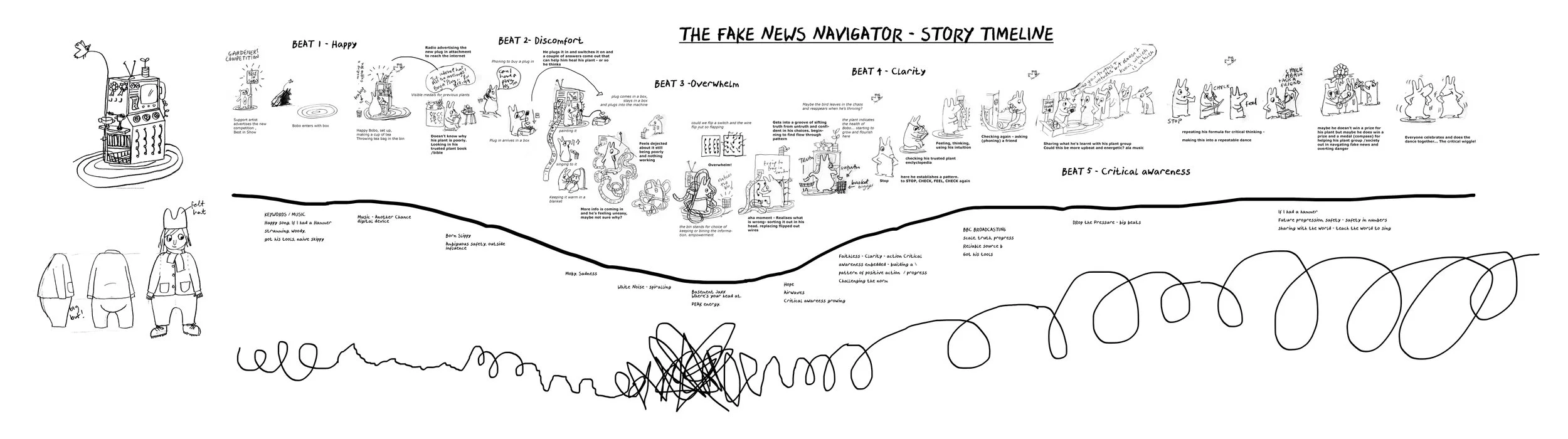
Working story document. Using music as a starting point, building story beats first & then building shape & rhythm from there, then adding detail for each scene with pencil.
From Picture Book to Stage
From the beginning we knew Bobo shouldn't disappear inside a mascot costume. We wanted the performer's face to remain visible so children could read every expression, every flicker of uncertainty and every moment of joy. It kept the performance deeply human and allowed children to connect emotionally rather than seeing Bobo as simply "an animal."
Bird, a familiar character from The Accidental Gardener, also made the journey onto the stage. In the original book Bird quietly symbolises hope and the return of life to the city, and we wanted that symbolism to remain. Small details like these ensured the play felt faithful to the world of Bobo and The Accidental Gardener. The book was inspired by my brother and my own feelings of overwhelm, so it’s a deeply personally, however globally resonant story.
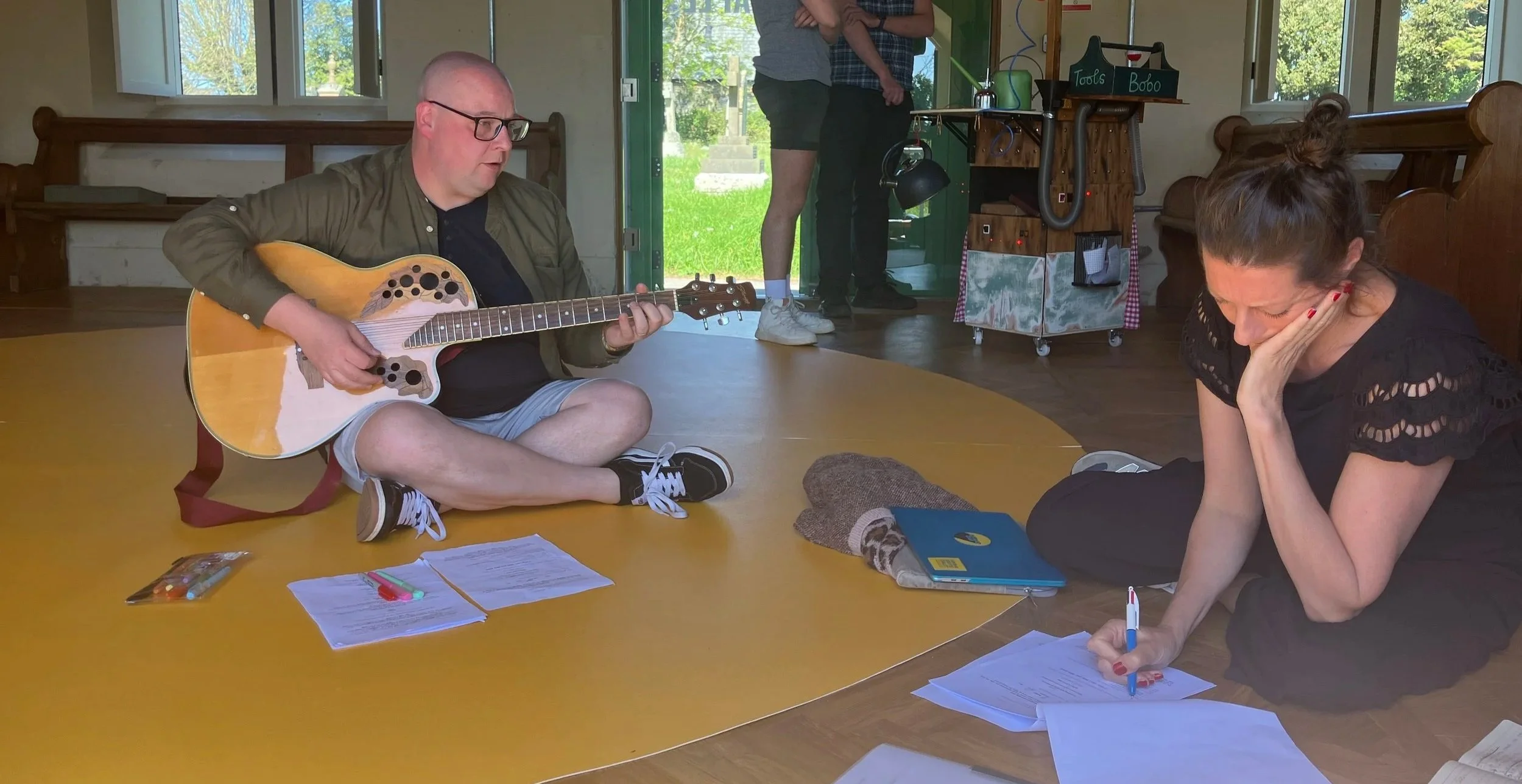
R&D with Makaton expert Rebecca Hulbert - Arthur’s Club and performer Marc Jenyon
Accessibility was equally important. Working with a Makaton specialist, we carefully wove signing throughout the performance. Not only did this make the production more inclusive, but it also helped simplify complex ideas into clear, memorable actions.
Like any creative project, the story constantly evolved. Together we mapped story beats, tested emotional highs and lows, rewrote scenes, removed ideas and rebuilt others until every moment felt purposeful and clear. From the first conversations in February to the final rehearsals at the end of April, it was an incredibly ambitious schedule, expertly guided by Guy Watson's project management.


Seeing Bobo Come to Life
Watching the production tour schools was equally exhilarating and terrifying.
As any creator knows, it's impossible to switch off the critical part of your brain. I was constantly spotting tiny details we could improve. But those thoughts were quickly drowned out by the joy of watching Berry (Berenice Cruse) bring Bobo to life with such warmth and sensitivity, beautifully supported by Marc Jenyon as Bird.
The children's reactions were extraordinary. Some erupted with laughter. Some shouted advice. One child shouted out “It’s okay Bobo, we trust you!” and I think most became deeply protective of Bobo.
By the finale they were chanting his name, and once Bobo finally learned to separate truth from lies, children were almost competing to hold the bin as fake information was thrown away.
Those moments told us everything we needed to know.
The story was working.
What Illustration Can Do
What moved me most throughout the entire process was the care with which every member of the creative team treated Bobo's world. They weren't simply adapting a story. They were investing in it.
As someone who normally spends their days alone at a drawing desk, seeing characters that had only ever existed in sketchbooks become living, breathing people was an extraordinary experience. Every prop, costume, performance and creative decision was rooted in the same values that inspired the original picturebook: kindness, empathy, curiosity and hope.
It also reminded me why illustration matters. The ability to translate a nuanced and complicated subject into something understandable and accessible to all. People often think illustration is about making beautiful pictures, but it has always been about making complicated ideas feel understandable. A picturebook can distil enormous concepts into a handful of images and very few words. That same way of thinking proved invaluable when trying to explain misinformation, trust and critical thinking to hundreds of children in just forty minutes.
Interestingly, while talking with the team at PK Porthcurno, they reflected that approaching the project from a picturebook illustrator's perspective had influenced how they were thinking about future family learning experiences. That was incredibly rewarding to hear. It reinforced my belief that illustration isn't simply decorative, it is a way of thinking, simplifying and communicating.
Why Cornwall?
There felt like no better place to tell this story than Cornwall.
Despite and almost because of its rural landscape, Cornwall is one of the most connected places in the world, with around a quarter of global internet traffic passing through the county via international subsea cables landing at Porthcurno.
It is also one of the UK's most creative counties, where storytelling, theatre and arts-based education continue to thrive. Bringing together communications, creativity and education felt like the perfect way to explore such an important subject.
Stop. Question. Sort.
By the end of the play, Bobo has learned that not everything the internet tells him is true. Together with the audience he discovers three simple steps:
Stop. Question. Sort.
The finale became the now much-loved Bobo Shuffle, with children enthusiastically signing and dancing to the bespoke songs singing those three words in Makaton before waving Bobo off the stage.
It's easy to think of my work as creating characters or colourful worlds for children to simply enjoy. But projects like The Fake News Navigator confirms to me that illustration does something much bigger. It can help children understand complex ideas, spark conversations and give them the confidence to ask questions. And if they leave with a new ability to sort truth from untruth by remembering the Bobo Shuffle and these three simple steps: Stop. Question. Sort. then Bobo's latest adventure has done exactly what we hoped it would. And as both an illustrator and storyteller, I can't imagine a more rewarding outcome.
The Bobo Creative Team
Marc Jenyon - Performer
Berenice Cruse - Performer
Jonathan Bray - Designer
Caroline Pedler - Writer & Story
Matthew Thomason - Composer
Fluxus CIC - Construction
Anna Finch - Costume
Arthur's Club - Makaton Support
Neal Megaw - Photography